

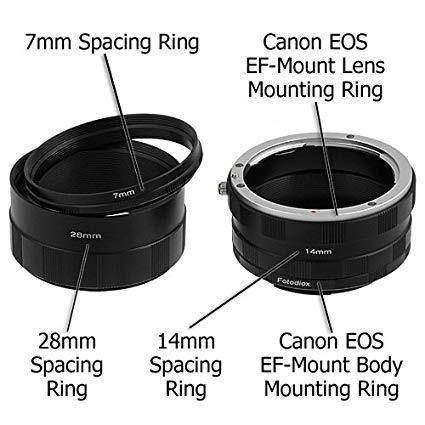
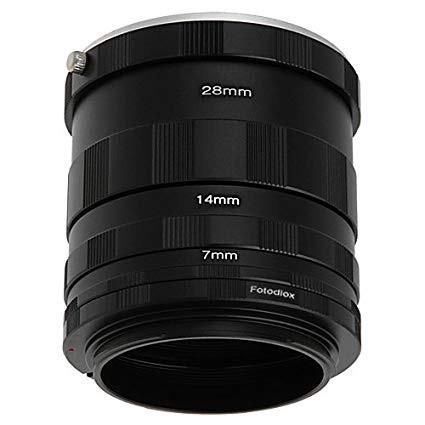
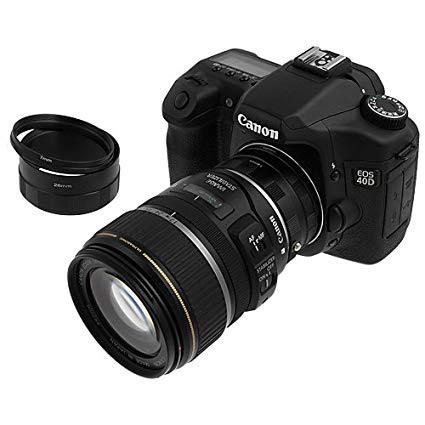
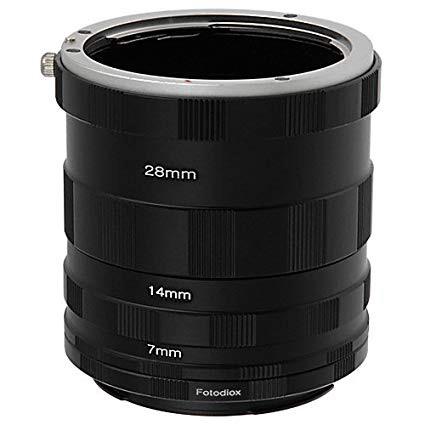
Fotodiox Canon EOS Macro Extension Tube Set for Extreme Close-Ups
Write a review
$1,48500 $1,98000

Fotodiox Canon EOS Macro Extension Tube Set for Extreme Close-Ups

Write a review
B003Y60DZO
Photo lenses 2025 Holiday Specials, Save 25%
Promotion expires within:
+
Add to wish list
Adorama
Bronze
Serving customers for more than 35 years, Adorama has grown from its flagship NYC stor...

City: US, Pasadena

Delivery
Pickup at your own expense
Tomorrow from 09:00 to 20:00, Store location
Free
Payment options
Apple Pay Google Pay Mastercard Visa
Cash, bank card, credit/installment payments, cashless payment for legal entities
Warranty and returns
Exchange/return of products of proper quality within 14 days Official manufacturer's warranty: 12 months
Features
Item Dimensions
6 x 6 x 6 in
Item Weight
3.53 ounces
Description
This fits your .
Make sure this fits by entering your model number. Will not alter optical quality All Metal Construction Multiple combinations available for multiple macro effects Includes a 24 Month Manufacturer Warranty
Reviews
3.7
Reviews: 20
5 stars
35%
4 stars
40%
3 stars
5%
2 stars
0%
1 star
20%
YakovGYP
4
My partner wanted to get back into photography and she wanted to upgrade from her older Rebel T1i to a newer camera and went with the Rebel T5 which was on sale. She was ecstatic when she saw how wonderful my pictures came out when I was shooting on a Panasonic G7 and with older Canon FD lenses using a focal reducer. We got this adapter to go with her Rebel T5 and she paired it with a vintage Canon FD 50mm f1.8 lens. We noticed a lot of haziness and softness at f1.8. I thought it may be the lens itself, maybe fungus or debris. We thoroughly checked the lens and its extremely clean, almost perfect. The adapter is clean as well. Also, the other thing I questioned was the crop factor since theres a glass in the adapter. I conducted a quick test. A tripod was set up 4ft from my test bench. I mounted my own Rebel T5 on it with both a vintage Canon FD 24mm f2.8 lens using this adapter and a Canon EF-S 24mm f2.8 lens. From the results you can see the crop factor on the vintage lens compared to the standard EF-S lens. Being at f2.8 also caused the haziness in the image. Overall the adapter is decent. For the price it does its job on being able to use vintage FD lenses on a Canon Rebel camera. Moving the f-stop up at least one above your lowest will help clear up your images and prevent the haziness. I didnt give the adapter a perfect five stars due to this concern and at the same time I avoided three stars because the cost is a lot lower than other adapters with glass elements. Its good for using vintage lenses but just keep in mind its limitations.
John C. Beane, IV
4
Having previously purchased the Fotodiox Pro FD lens adapter, and being interested in extending my range for long distance shooting, I purchased this budget alternative for the Canon teleconverter. One of the features that really caught my eye was the compatibility with EF and EF-S lenses, and the pin set for AF and IS. So far, the results have been as expected. The effective range is dramatically longer, and the image quality suffers only minor degradation to the amateur eye. I will say that the camera body does not recognize the extended focal length, therefore, your images will show the focal length of the lens as if there were no extender attached. This is not a deal breaker, especially at this price, but it would be nice if the information were able to be translated accurately. The product exemplifies a very high standard for build quality, as evidenced by the workmanship and materials. The extender feels durable and solid, and the mount is both smooth and tight fitting. The release button does not depress straight down, rather, it is pressed sideways to release the lens from the extender. This is not immediately intuitive, and may take some time to get used to, but no negative effect on function or quality. If you want to extend your focal range, but cant afford lenses in the thousands of dollars, this is a very suitable option.
Amazon Customer
4
These work as advertised. They lock up real tight. One comment to everyone that has said that theyve had trouble getting them off of their camera once snapped in - If you look at the set you will see the end that attaches to your camera has that small bolt sticking out. You have to push that forward (away from the camera in line with your lens) to get the ring to release from your camera. It is designed to work like it does. If I had a suggestion for the manufacturer it would be that the little bolt thing-a-ma-doo-dad works ok (once you realize how to get it to release) - using a lever style or something that is angled so that it is easier to get too - and / or - simply putting an arrow with the words push -> to release . . . . would both make it more noticeable aiding the people who buy the product . . . and aiding you by not having them return something as defective after having tried to not destroy their camera getting it off - because you didnt give the most simple description of how to get it to release.) They do work and work pretty smoothly once you realize what you have to do to get it to release but the other issue with how you have this built is theres not a lot of space between the camera body and your little bolt head. Anyone considering buying these - no worries they seem to work just fine but its pretty important to know how to get the thing to release - and that little gizmo is really the only thing about these that isnt what Id call pretty decent manufacturing. It works its just kind of crude compared to the rest of the product.
R. A.
4
I think its great if you need it for still images like moon and astrophotography. I used it with my canon T6s and the new 55-250 mm lens and got a Great result with Moon photos. The image was still was sharp as you can see here. The image was cropped but never enhanced in lightroom, so if you enhance it it might look sharper than that. Its a great purchase if you want good quality astrophotography and youre on low budget. I paid $100 for it, probably a price of $65 - 70$ would be more reasonable. I gave it 4 stars because the autofocus doesnt work as advertised (kept going back and forth and never focused) and the mounting is not very smooth. Otherwise its a great teleconverter. Image capture settings: 250 mm (x2 -> 500 mm), f/8, 1/80s. ISO 100
dali_lama_2k
4
I, like most other people who get this, have a few FD lenses left over from my film days and want to put those things to work! I am very happy with the construction and fit (all metal, no wobbling or twist). Installation to the lens was a little tricky but, once installed, fit to the camera body was nice and easy with a firm *click* once in place. I use both the built-in aperture ring and the lens aperture, depending on my situation. To achieve accurate focus, I found it necessary to focus while WIDE OPEN. This helps to eliminate the false focus while within the images DOF. Focus, compose, close and shoot. Setting mode dial to Av but keep in mind that you lose about 1 stop due to the adapting optics (Exposure Compensation to +1 helped in some situations) and I notice some CA/color fringing due to them as well (somewhat correctable in post-processing and no impact at all when going for monochrome). The optics ARE removable, Im just not sure how. I also got an Ef-S focusing screen and a third-party split-prism focusing screen. The Ef-S screen helps focus by making out-of-focus areas MORE out-of-focus, and gives a more accurate depiction of depth-of-field (particularly useful for f/2.8 or faster lenses). The split-prism screen simulates the screen that we USED to have in our film cameras. My lens being f/4, I found the Ef-S screen to be most helpful but (if you have a faster lens) you should do just fine with any screen. Giving 4 stars because of the CA and poor instructions, but I am overall very happy to have made this purchase.
Michael Logusz
4
BEFORE YOU PUT THIS ON YOUR LENS: carefully tighten the tiny screw that keeps the little release tab from flexing sideways. If you don’t this will get stuck on your lens and you’ll be using dental picks and sewing needles for hours trying to dislodge it. That’s what happened to me. After getting it off and tightening the screw so the lever/tab would actuate freely—but not flex—this thing worked great. I can now use a bunch of (1960s-1970s) Nikkor/Nikon/Nikkormat lenses on my new Canon T2i. Yes, it will let you use those ancient lenses with the crazy bayonet prong thingy sticking up that used to fork into the SLR prism meters of the old film cameras. The short answer: Yes, this adapter let me use old Nikon/Nikkor lenses on my Canon. They were really old lenses and most had that weird f/stop meter fork prong sticking up from the f/stop ring. I’m very happy with this purchase. This worked with these old lenses I happened to have lying around, which I’ll list because some online sources say some of this won’t/will fit on digital cameras, but if it’s an old Nikkor it probably will work with this adapter onto your Canon Body. Here’s what I had that worked: Now the really LONG answer with all sorts of cautions, opinions, etc. that you may or may not find interesting or useful: WARNING #1: BEFORE YOU PUT THIS ON A NIKON/NIKKOR/NIKKORMAT LENS make sure that the screw that holds the little black lever tab on is tight! If it’s loose the lever tab will flex sideways and not really go up and down so then it won’t pull the pin upward, which will jam this adapter onto your lens. This happened to me and the little pin had to be pulled up with a dental pick and an xacto blade while unscrewing the adapter (righty loosey!). So: test to make sure the release pin moves up and down with no sideways play. Once off the lens (it worked fine on the other 5) I used lock tight on the tiny screw and tightened it. I made sure it was still loose enough that the black lever-tab could operate the locking pin up and down. Eventually I’m going to get one of these for each of my 6 Nikkor lenses along with 6 Canon endcaps (because with the adapter on the rear of the lens it is Canon size now and the old Nikon endcaps wouldn’t fit anymore). WARNING #2 WHAT LENSES CAN I USE: well, pretty much anything that has the 54-year-old-and-still- in-use Nikon ‘F’ mount. Nikon/Nikkor/Nikkormat SLR cameras have been using the same mount since 1959, so if you have an ancient lens for these film cameras there’s a pretty darn good chance this ring will let you use them on your Canon. By the way: none of my lenses actually said "F" or "F Mount" on them: they had all sorts of other letters. F is the mounting system, not the lens type/name. BUT YOU MUST BE CAREFUL!! A few of the old Nikkor lenses had a crazy metal tab that sticks about an 1” into the camera. These will NOT work—unless you use a dremel tool to cut that tab off, then it’ll work fine. If you don’t cut that huge tab off then it will smash into your mirror. I’m NOT talking about the little black metal tabs that are on many of these lenses and look like tiny nubby cute rabbit ears like upside down ‘L’s; or the low black or chrome curved ridges on the rear of the lenses—these are usually fine to have. Most of my lenses had two or three rabbit ear tabs and worked fine. You can’t even see them when the adapter is on. The thing you DO have to be careful of is a (rare) SHARP & HUGE ‘L’ thing with the top of the ‘L’ poking into the camera body. . If you have a huge ‘L’ shaped tab that sticks past the adapter and into the camera: STOP! You need to remove that tab. Also, I’ve read of some of the older lenses had really big curved flanges—like a shark fin that would have to be dremeled off. I can only speak to the 6 lenses I tried. Mine just had normal flanges (black and chrome) and plastic rings and spikey blocky things, but no huge shark fins. Your mileage will vary. MAKE SURE NOTHING WILL HIT YOUR MIRROR OR THE ELECTRICAL CONTACTS OF YOUR CAMERA BODY. A few Nikon lenses have a really tall fin/flange that goes almost all the way around. These may have to be removed as well. It should be pretty obvious if you’ve got a lens that will need grinding. Maybe I just lucked out with half-a-dozen that worked with no grinding. It should be really obvious and I don’t mean to make anyone paranoid. Personally, I’m not in the mood to grind anything, so if I dig up a lens with a tall ‘L’ or a huge shark fin flange, I’m probably just not going to use it—unless it’s one of the huge flanges that is screwed on: then I’d take it off and try. To be clear: ALL these old lenses will have LITTLE tabs and ears sticking out of them. It’s just any huge ones that would hit your mirror that could be a problem. Looking online it seems *most* old Nikkor lenses don’t have these huge tabs anyway. MY EXPERIENCE: With the adapter on each of my lenses NOTHING stuck past the adapter going into the camera Happily, NONE of the 6 mega-old lenses I got from a family member had any really tall tabs or flanges or L-thingies that interfered with fitment. I had three old Nikon film SLR camera bodies (F body, EM body and a Nikkormat body) with six old lenses that worked interchangeably with them all. Since 1959 Nikon has used the ‘F-mount’ system on their SLRs, so there are many Nikon lenses in the world that will fit your Canon with this adapter. I have a Canon T2i. MOUNTING: remember that RIGHTY IS LOOSEY on Nikon F-mount lenses! A major source of irritation if you’re used to righty tighty. Oh, and many of the lenses have all sorts of letters on them—none actually said ‘F’ or ‘F Mount’ on them, so yours probably won’t either. The adapter fits VERY tight onto the lenses-and NORMAL tight onto the Canon body. It’s so tight on the lens that you’ll probably end up buying one for each lens so you can just leave them on—which is since you’re probably not going to put them back on your old Nikon film camera anyway (ie, the reason you’re shopping for adapters in the first place). Once in place it goes on/off the Canon body like any Canon lens. Nice and easy and clicks into place. YES IT WORKS: old Nikkor/Nikon/Nikormat lenses, even the ones with that crazy metering/fstop FORK thing on the top/outside work just fine! My ancient 1960s-80s Nikkor lenses fit on the Canon and the camera meters through them. I’ve noticed that the faster (f1.8) Nikkor lenses overexpose slightly on auto-everything. Fine: it’s a DSLR, just adjust your exposure and see what you get. I also bought an adapter like this one that lets me use my old Olympus OM Zuiko lenses from the 70s and the fast f1.8 50mm Olympus lens also overexposes a little. The 500mm telephoto and the slower lenses meter fine using auto-everything on the Canon (I used the silver rectangle with the line through it showing “no-flash” selected on the rotating knob of the Canon). F/STOP: my Nikkor lenses all stopped down (depth-of-field preview mode) because nothing on the camera or adapter hits the old lens levers ~that’s a GREAT thing, you can use different f/stops instead of just wide open because of this. The bigger the f/stop you dial in the darker the view is and the larger the depth-of-field. I like that. I don’t have to hold down any depth-of-field preview button or anything. I just get the f/stop I want by turning the ring on the lens, focus by turning the other ring on the lens and snapping a photo. Some people might have a problem with this: the larger the f/stop number the darker the view is, which makes it harder to manually focus properly. When you use these lenses on old film cameras there is a lever that opens the f/stop until the shutter is tripped (or if you held down the depth-of-field preview button either on the lens or the camera body depending on the brand)—which is why the view wouldn’t darken on film cameras no matter what f/stop you chose (although some lenses didn’t have this feature and still would show a darker view depending on f/stop). Anyway: this is a good thing. You see what your f/stop choice does to your focus and since the Canon can meter with these old lenses everything comes out fine in the end. My Tamron 500m for Olympus is like that: no matter if I put it on a film SLR or a DSLR the f/stop changes the brightness and depth of field you see while looking through the lens and trying to focus-there is no non-preview mode. I’ve read (but not sure if true) that even though most Nikon DSLRs will mount old “F’ mount lenses SOME Nikon DSLRs supposedly cannot METER through them. That doesn’t sound like fun. NO IT WON’T AUTOFOCUS: my Nikon lenses are so old they didn’t autofocus in the first place, so this wasn’t an issue. There is no sensor on this adapter, so you don’t get any sort of autofocus confirmation either. Again, my lenses were from early 70s so they never did that in the first place. Some of these types of adapters will have a circuit board thingy on them for use with newer lenses: you still have to manually focus, but the camera will notify you when you’ve achieved focus by blinking a light or something. I’ve read that these can and do burn out after a while anyway—so I went with this cheapy adapter. Even if I did have lenses with some electronic features I wouldn’t want them communicating with my nice new camera body through a cheap adapter and possibly shorting something out: but who knows, maybe they work awesome. The only autofocus lenses I own are the ones that came with the new Canon T2i kit. All the old Nikkors (and others) I have lying around are manual focus to begin with. FOCUS: some lenses (possibly) won’t be in focus at infinity if you dial the focus ring all the way out. I didn’t have that issue, but I’ve read that you just focus all the way out, and then *in* a little and you’re fine. So, no biggie there: look with your eyes—either it’s focused or not. WHY DO THIS? Because the Canon T2i (and probably other EOS bodies) meter through anything you can adapter-ring or duct tape onto the front of them you can use totally awesome lenses that you can find ultra-cheap online or even at garage sales. You can buy a box of expensive “film camera” lenses for five bucks and laugh when they ask you “film is dead, what are you going to do with those old lenses?” Adapt them! I spent a lot of money in the past on nice lenses, and with a few cheap adapters I can re-use them on my Canon. Since Canon’s *video* is considered by many to be better than some of Nikon’s models (no wavy jellybeany video while panning, manual controls, longer HD record time, 1080 HD, etc.) you’ll find lots of people shooting VIDEO with Nikon/Nikkor lenses on Canon Bodies. Why-it looks great and is lots of fun! IN SUMMARY: -Righty loosey, lefty tighty with Nikon lenses. -Make sure the black lever tap pulls the pin upward, if not: tighten the screw *before* jamming it onto a lens; or, buy an adapter for every lens you have and just leave them on (and then get CANON rear dustcaps—not Nikon—for the rear of each lens). -Make sure nothing is sticking past the adapter and then they’re be nothing to poke your mirror and break it. -My six lenses (listed) worked just fine. Your mileage may vary due to manufacturing changes over the decades. -It’s nice to be able to use old expensive lenses again for cheap. Now you can hunt around your parent’s/grandparent’s basement and double or triple the amount of lenses you have. -IT IS A LOT OF (CHEAP) FUN! -Look around for other old lenses: Canon’s have adapters for tons of other manufacturer’s lenses (like Olympus OM Zuiko). I spent a measly few bucks on a couple adapters and all of a sudden I’ve got almost two dozen (very high optical quality) lenses for my new Canon DSLR for very little money. I took a star off for the 45 minutes of worry and dental-picking to get it off the first time it jammed. After that it was smooth sailing. If I had tightened the screw BEFORE jamming it on a lens I probably would still have given this 4 stars just for the ‘ify’ design of the release lever. Cheers, Mike from Detroit
J Clifton
4
Lets be honest -- this puts cheap glass in the optical path so a picture can be taken. The quality is not great glass — its cheap glass. The point is to be able to use good lenses with good cameras that could not otherwise be combined. In my case, Im using Rokkor-X Leica glass on my Canon 70D. More specifically, Im using a top notch Minolta macro lens, plus a very nice Minolta 1.2 50mm lens. The low quality glass give effects of softness that can be "arty" and bring a cachet to the image that is serendipitous and engaging. Ive obtained some excellent images, none of which are critically sharp, because cheap glass. So if you buy this with the right level of expectation, youll be pleased and have a new set of tools in your arsenal, and some fine lenses wont wind up in landfill. One real caution: One CAN remove the glass and make the lenses that are "adapted" focus short of infinity and with the benefit of zero.zero degradation of the image. However, when you remove the unit containing the glass, the glass segments fall apart. Any alignment (laugh) is lost, and you now have dust and fingerprints on the glass when you put it back together. So, dont.
foxposte
4
I bought this to use with my Canon 75--300 zoom lens and Canon EOS20D camera. I have used it with manual focus (mostly because I forgot it could be used in autofocus mode) but with bird photos, in trees, focus can be tricky. Im new to photographing birds--most move so quickly, especially the warblers, that I feel lucky to get a half-way decent shot at all. Ive used this extensively on a week-long trip to Padre Island, TX. I photographed shore birds and wading birds and ducks, esp. at Leonabelle Turnbull Birding Center, and was very pleased with the sharpness of my shots in good lighting conditions. With any teleconvertor, low light conditions are tough, so it would be best to remove it for those shots. I didnt do this, but recommend you buy a cap, which costs extra, to protect the top when youre not using it. Ill get one, but shipping costs almost as much as the cap, so I guess Ill make do with a ziplock bag until I have another order to place. Ive had to learn how to disengage the lens from the teleconverter--theres a fat button that you push away from the lens. It isnt intuitive, but not a problem once youve figured it out. This has also been useful to use on my shorter lens, too. It gives you a lot of flexibility for a very reasonable price. I have no issues with the quality of this product, but cant comment on the autofocus feature, as I havent given it a trial yet.
You may be interested
  • Bestsellers
  • Recently Viewed
 
Fast and high quality delivery

Our company makes delivery all over the country

Quality assurance and service

We offer only those goods, in which quality we are sure

Returns within 30 days

You have 30 days to test your purchase