











Capture every moment with crisp detail and smooth performance — today’s best cameras make every shot effortless, from quick snaps to creative projects.
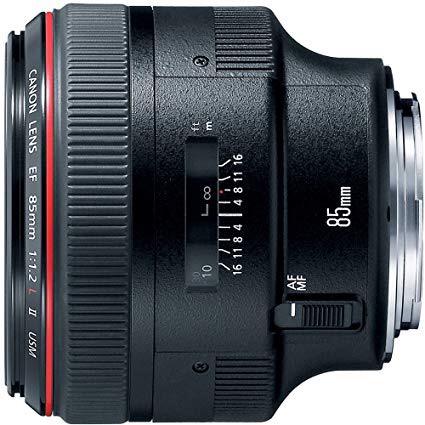
Make sure this fitsby entering your model number. f1.2 maximum aperture Ring-type UltraSonic motor (USM), Focal length : 85mm, Closest focusing distance : 3.2 feet EF mount, medium telephoto lens, High-speed AF and circular aperture create shallow depth-of-field 111mm focal length for APS-H sensors, 136mm for APS-C sensors, Lens not zoomable
This is a very beautiful lens that takes nice soft pictures. However I dont like it I often wished I had not sold my 85mm 1.8 and know this sounds crazy but the 1.8 took stellar photos and that autofocus was fast and precise. With this lens its very slow and at 1.2 its really hard to nail the focus and come on the whole reason to get this lens its to shoot it wide open. I know part of the appeal is to have a nice soft picture with beautiful bokeh and this does produce fantastic bokeh I feel that the 1.8 does both for me . Aside from that this thing is monstrously heavy and awkward to hold . Im usually a 50 guy and love primes and have the 35mm f2 or 1.4 in my bag along with a 85 and this wasnt practical for me so I sold it. For what this cost I would recommend the 70-200mm II with IS youll get really fast and exact focus and wonderful bokeh especially if you can take a couple steps back and zoom to 200 .It sounds crazy because I drooled over this lens for so long until I was able to save to buy one but these are just my two cents and why.
shedeus
4
Ive had a few weeks to play with this lens and while I am thouroughly impressed with the way it manages backgrounds and the how it resolves fine details, I am dissappointed with one thing reviews here have not typically mentioned, knocking off one star. First the positives! 1) Incredible bokeh at wide apertures: I am simply amazed at the background blur created wide open to f2.8. Its been argued, why shoot at 1.8 or 2.8 when other lenses can do that at a fraction of the price? Its the WAY this lens renders out-of-focus elements at wide apertures that sets it apart. 2) AF accuracy: I use a 5D classic, and at inifinity and minimum focussing distances, there is 0 front focussing or back focussing issues at f1.2. Im able to achieve this accuracy in low contrast, indoor lighting, which is key for a fast lens. Without micro adjust on my SLR, focussing issues are non-negotiable when it comes to lenses that find a home in my bag. 3) Resolution: Extremely fine detail is captured at 1.2. Stopping down is only required for additional depth of field. 4) Manual focus: The consensus is the fly-by-wire method of focussing isnt great. Granted, Im no fan of how loose the focussing ring turns, but I have no problems manually focussing. In practice, it feels no different manually focussing than any other lens I own, and Im pleasantly surprised by how much I enjoy doing so with this lens. At an aperture of 1.2, great care needs to be taken for accurate focussing at any distance. I happen to use a high precision, manual focussing screen (Ee-S) to aid this process, something I dont believe I could do with the stock focussing screen with any confidence. 5) Focussing speed seems to come up a lot for this lens. Does seem sluggish compared to my 70-200 2.8 II, but shooting fast action or sports is not the intention with this lens. Rather, Id been using my 100mm L for portraits almost exclusively. Its more than capable of keeping up in portrait sessions with active children and family pets. My only dissappointment with this lens: 1) LOCA abberation - short for Longitudinal Chromatic Aberration. Ultra fast lenses typically exhibit LOCA in some form at wide apertures, and this lens is no stranger to this. "Bokeh fringing" for this lens is most apparent in highlights and is especially noticable as a green tint for bokeh in the background and a magenta tint for bokeh in the foreground. I was surprised to see how much of this abberation showed up in actual, real use images (not talking test charts here). While all fast lenses deal with LOCA, I cant help but feel Canon could have done a much better job controlling this. Unlike the typical chromatic abberation that can be easily corrected, LOCA is difficult or sometimes impossible to correct in post because of the color shift that occurs in highlights, out-of-focus elements, etc. 2) Im nitpicking now! I dont like the lens hood at all. It feels very cheap, and clasps onto the lens using these small clips, requiring you to press on 2 hard-to-grasp tabs at the base of the hood. It all feels very cumbersome for a lens hood that feels unusually wide for a short-tele. In conclusion, I adore this lens. For what it does, nothing else in my kit can quite replicate its efforts. Im more than happy to make room for this tool in my kit. Its unfortunate however, that in pursuit of speed, incredible resolving power, and undeniable background control, excessive LOCA abberation seems to be the unfortunate compromise. No free lunch it seems!
Please sign in so that we can notify you about a reply